
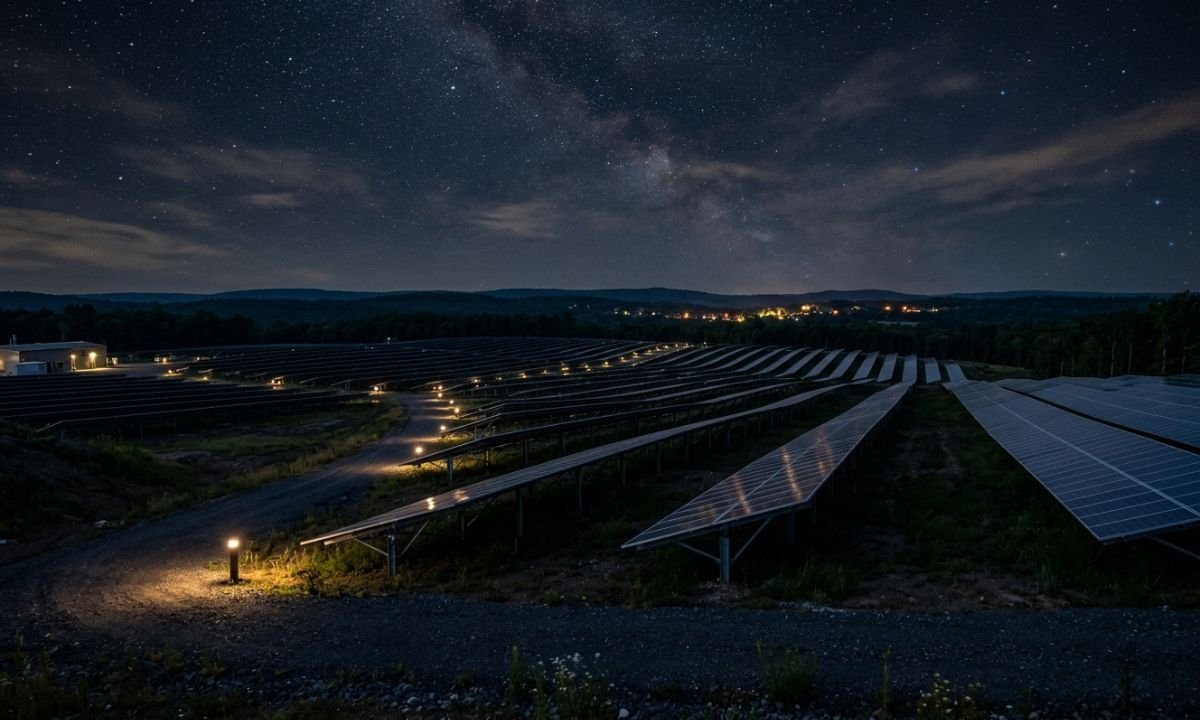
Solar panels have always needed sunlight to work. But that is changing fast. Scientists have created new panels that can make power even after dark. These are called night solar panels, and they are turning heads in 2026.
You might wonder how a panel can work without the sun. The answer lies in heat. Night solar panels capture heat that the Earth releases into the cold night sky. This heat is turned into a small but steady flow of electricity.
This new technology matters more than ever right now. Homes and businesses want power all day and all night. Night solar panels could help fill the gap when the sun goes down. They may soon become a key part of clean energy for everyone.
What Are Night Solar Panels & How Do They Work?
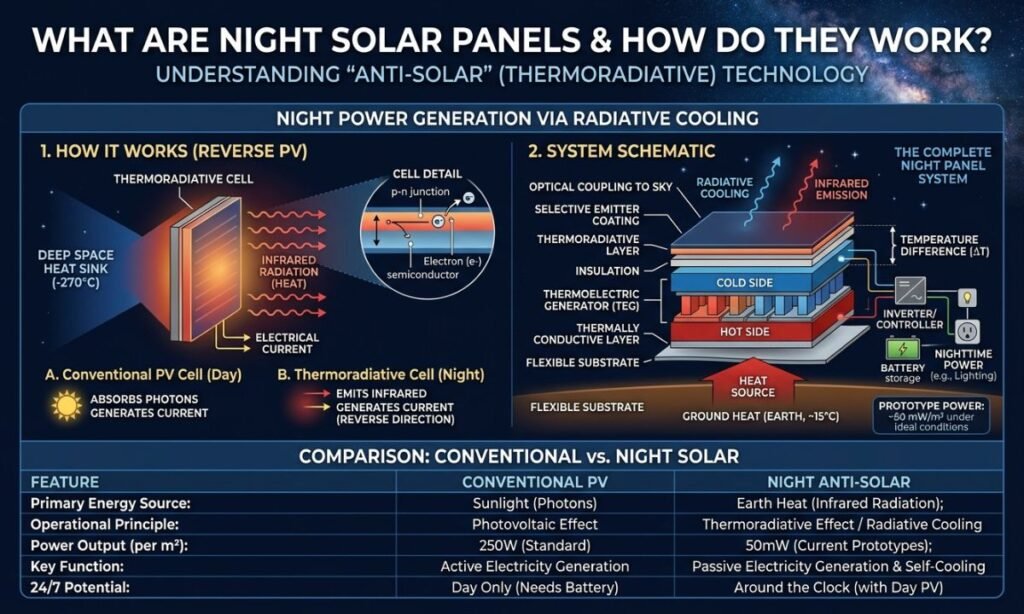
Night solar panels are a new kind of solar technology. They are built to make electricity even when the sun is gone. Normal solar panels stop working after sunset. Night solar panels try to fix that problem.
These panels do not use sunlight the way normal panels do. Instead, they use heat and cold from the air around them. This idea sounds strange at first, but it is based on real science. Let’s break it down in simple words.
How Night Solar Panels Work
Every solar panel gets warm during the day. At night, that heat starts to leave the panel and move into the cold sky above. This process is called radiative cooling.
Radiative cooling happens naturally every night, everywhere on Earth. You may have noticed that car windshields get frost on clear, cold nights, even when the air is not that cold. This happens because the windshield loses heat to the sky faster than the air around it. Night solar panels use this same natural effect to make power.
The Science Behind It
When the panel loses heat to the sky, it becomes slightly cooler than the air around it. This creates a small temperature difference between the panel and the surrounding air. Scientists found a way to turn this tiny temperature gap into electricity.
A special device called a thermoelectric generator is attached to the panel. This device can sense the difference between two temperatures. When one side is warmer and the other side is cooler, it pushes electrons to move. This movement of electrons creates a small electric current.
Two Main Methods Scientists Use
Right now, researchers are testing two different ways to build night solar panels:
- Thermoelectric method – A generator is added to a regular solar panel. It captures the heat that escapes at night and turns it into power.
- Thermoradiative method – A special type of solar cell releases infrared light into the cold night sky instead of absorbing sunlight. This flow of energy in the opposite direction still produces a small current.
Both methods are still being improved. But both prove one simple fact: the night sky is cold enough, and the Earth is warm enough, to create a small but real source of power.
Why the Power Output Is Still Small
Night solar panels do not make as much electricity as normal solar panels. A regular panel can produce around 150 to 200 watts of power per square metre in strong daylight. A night solar panel, on the other hand, currently produces only a few milliwatts to a few watts per square metre.
This is enough to run very small devices. It is not yet enough to power a full house. Scientists are working hard to raise this number every year.
Stanford Night Solar Panels
Much of the recent progress on this topic comes from Stanford University in the United States. A research team led by Professor Shanhui Fan built one of the first working night solar panels.
The team attached a thermoelectric generator to a normal solar panel. At night, the panel released heat into the sky and became slightly colder than the air. The generator used this gap to make electricity.
In their first tests, the Stanford panel made about 50 milliwatts of power per square metre. This is a tiny amount. But it was enough to light a small LED bulb. Later versions of the design pushed this number much higher, reaching more than 2 watts per square metre in improved lab conditions.
Here is a simple summary of the Stanford research progress:
| Stage of Research | Power Output | What It Could Power |
| Early test panel | About 50 mW per sq. metre | A single small LED light |
| Improved design | Over 100 mW per sq. metre | Small sensors, tiny lights |
| Advanced lab version | Over 2 W per sq. metre | Small sensors, remote monitoring tools |
The Stanford team calls this technology a “proof of concept.” That means it works, but it is still at an early stage. It is not yet ready to be sold in stores. Even so, this research is seen as one of the biggest steps forward in solar science in recent years.
Night Solar Panels Technology
Night solar panel technology brings together a few different fields of science. Understanding these parts makes the whole idea much easier to picture.
Thermoelectric Generators
A thermoelectric generator is the heart of most night solar panel designs. It is a small solid device with no moving parts. It works using something called the Seebeck effect, where a temperature difference between two sides of a material creates voltage.
These generators are already used in other places, such as space probes and some industrial machines. Adding them to solar panels is a fairly new idea.
Thermoradiative Cells
Thermoradiative cells work almost backward compared to normal solar cells. A regular solar cell absorbs light from the sun to make power. A thermoradiative cell instead sends heat energy outward into the cold sky and produces a small current from that outgoing flow.
This method is newer and still mostly limited to research labs. But many scientists believe it holds strong long-term potential.
Materials Used
Night solar panels often use special coatings that:
- Release heat efficiently into the sky
- Resist absorbing heat from the surroundings during the day
- Stay stable in different weather conditions
Choosing the right materials is one of the biggest challenges researchers are working on today.
Night Solar Panels With No Sunlight
Many people find it hard to believe that a solar panel can work without sunlight at all. The truth is simple once you understand the idea of heat flow.
Sunlight is just one type of energy. Heat is another type of energy. Night solar panels do not need light particles hitting them. They only need a difference in temperature between two surfaces.
Here is an easy way to picture it:
- During the day, the sun heats the Earth’s surface.
- At night, that stored heat slowly escapes into space.
- As heat escapes, the surface becomes cooler than the air.
- This small gap in temperature is captured and turned into electricity.
So night solar panels are not really working “without energy.” They are working with a different kind of energy source: heat leaving the Earth rather than light arriving from the sun.
Availability in Pakistan
Many people in Pakistan are searching for night solar panels because they want non-stop power at home. It is important to know the real situation before buying anything.
As of now, true night solar panels, the kind based on radiative cooling and thermoelectric generators, are not commercially available in Pakistan. They are still lab-based research products in the United States and a few other countries.
This means:
- You cannot walk into a solar market in Lahore, Karachi, or Islamabad and buy a true night solar panel.
- Any product advertised online as a full night solar panel for home use should be treated with caution.
- Local markets mostly sell regular solar panels combined with batteries, which is a different and proven technology.
Some sellers use the term “night solar panel” loosely for solar-powered LED lights or garden lamps. These are simple products that charge a small battery during the day and turn on an LED bulb at night. They are useful, but they are not the same as true night-generating solar panel technology.
Benefits of Night Solar Panels
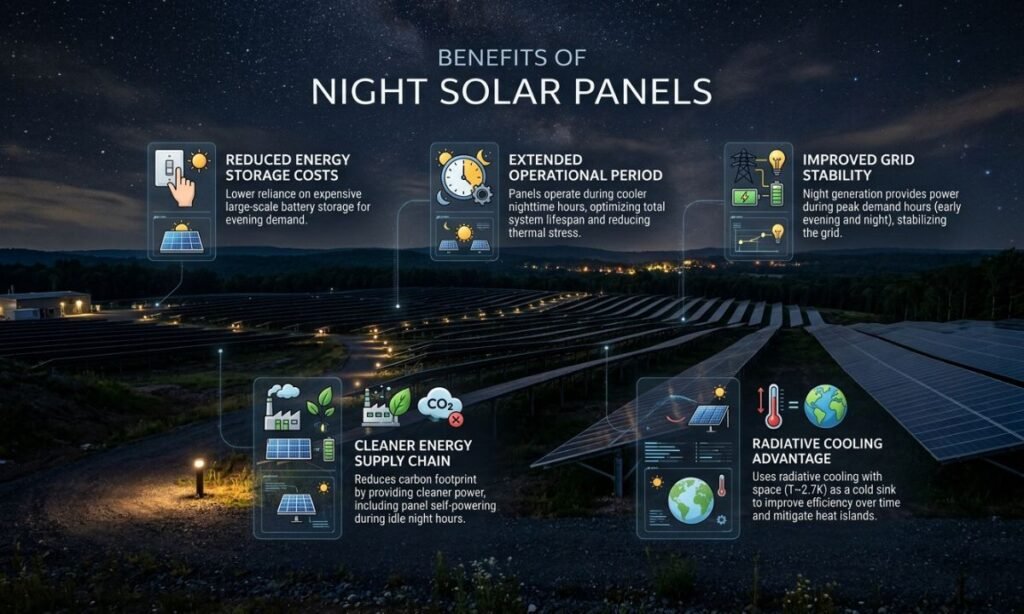
Even though this technology is still growing, its possible benefits are exciting. Here are the main advantages that make researchers and homeowners interested.
Cost Savings
Once this technology becomes common, it could lower electricity bills further. Homes already using solar power during the day could add night generation as a bonus, cutting down on the amount of stored battery power needed.
Environmental Benefits
Night solar panels do not burn fuel and do not release smoke or harmful gases. They use natural heat loss, a process that already happens every night with no extra input needed. This makes the technology very clean and eco-friendly.
Long-Term Financial Stability
Energy prices often rise every year. A home that can generate power both day and night depends less on the public power grid. Over many years, this could protect families from rising electricity costs.
Reduced Energy Loss
Right now, homes waste some solar heat every night as it escapes uselessly into the sky. Night solar panels turn this “wasted” heat into something useful instead of letting it disappear for nothing.
Here is a quick summary table of these benefits:
| Benefit | What It Means for Homeowners |
| Cost Savings | Lower electricity bills over time |
| Environmental Benefits | Clean energy with no pollution |
| Long-Term Financial Stability | Less dependence on rising grid prices |
| Reduced Energy Loss | Uses heat that would otherwise be wasted |
Day Night Solar Panels Price in Pakistan
People often search for “day night solar panels,” hoping to find one panel that works both in sunlight and after dark. Right now, no single panel of this kind is sold commercially anywhere in the world, including Pakistan.
What Pakistani markets do offer is a combination system:
- A regular solar panel that works during the day
- A battery bank that stores extra power
- An inverter that supplies stored power at night
This setup gives people “day and night” power, but the electricity used at night was actually made during the day and simply stored for later.
Here is a general look at regular solar panel prices in Pakistan today, since these are the real products currently available:
| Panel Type | Price Per Watt (Approx.) | Notes |
| Standard P-Type Panel | Rs. 28 to Rs. 36 | Common and budget-friendly |
| N-Type Panel | Rs. 37 to Rs. 44 | Higher efficiency, higher price |
| Bifacial Panel | Rs. 35 to Rs. 43 | Captures light from both sides |
Prices can change often due to the dollar exchange rate, import taxes, and market demand. Always check current rates with local dealers before buying.
Night Solar Panels Price in Pakistan on OLX
Some people search OLX and similar marketplaces hoping to find true night solar panels for sale. It is important to be careful here.
Most listings that appear under this search are actually:
- Solar-powered garden lights and lamps
- Solar rechargeable torches
- Small solar security cameras with night vision
- Regular solar panels being resold
None of these are the thermoelectric or thermoradiative night panels described earlier in this article. If a listing claims to sell a full “night solar panel system” that generates real household electricity after dark, treat it with strong doubt. This technology is not yet sold anywhere in finished, ready-to-use form.
Price of Night Solar Panels in Pakistan
To put it plainly: there is currently no official, fixed price for true night solar panels in Pakistan. This is because:
- The technology is still in research and testing stages worldwide
- No verified company is manufacturing them for public sale yet
- Pricing cannot exist for a product that is not yet commercially produced
Anyone quoting an exact price for a “real” night solar panel today is likely referring to a different product, such as a solar light, a hybrid day-night system, or a regular panel paired with a battery.
Future of Night Solar Panels in Pakistan
Pakistan already has strong interest in solar energy. Many homes use solar panels to deal with high electricity bills and load-shedding. This makes Pakistan a country that could benefit greatly once night solar panel technology becomes ready for the market.
Here is what the future may look like, based on current research trends:
- Short term (next few years): Research continues mainly in labs in the United States and other countries. Pakistan is unlikely to see commercial night solar panels yet.
- Medium term: As power output improves, small night solar devices may appear for sensors, outdoor lighting, and remote monitoring tools.
- Long term: If efficiency keeps improving, larger night solar panels could be paired with daytime panels to offer close to round-the-clock solar power for homes.
For now, Pakistani households looking for 24-hour solar power should continue using tested solutions such as solar panels combined with battery storage and net metering. These systems are proven, available today, and already helping many families reduce their electricity costs.
FINAL WORD
Night solar panels are a small but real step forward. They show that clean energy keeps growing in new ways. Even something as simple as darkness can now create power. This is exciting news for anyone who cares about the planet.
This technology is still new and not fully grown yet. The amount of power it makes is small right now. But scientists keep testing and improving these panels. Over time, they could become much stronger and more useful.
The bigger goal is round-the-clock clean energy. Regular solar panels work all day, and night panels could work all night. Together, they may give us power every hour, without a break. That would be a huge win for homes and the environment.
In the end, night solar panels offer real hope. They prove that innovation never really stops. As the technology grows, it could change how we think about energy. The future of solar power may truly never sleep.
FAQs
Is there any solar panel that works at night?
Yes, but only in research labs so far. Scientists have built experimental panels using radiative cooling and thermoelectric generators that produce small amounts of power after dark.
How much does a 1000 watt day-night solar plate cost in Pakistan?
There is no fixed market price because true “day-night” panels aren’t sold commercially yet. A regular 1000-watt solar setup, however, typically costs around Rs. 35,000 to Rs. 44,000 based on current per-watt rates.
Are solar panels effective at night?
Normal solar panels stop generating power at night since they need sunlight. Only special experimental night panels can create a tiny current using heat loss instead of light.
How many AC can 10kW run?
A 10kW solar system can usually run 4 to 6 standard 1.5-ton inverter ACs, depending on other household loads running at the same time. Exact numbers change based on inverter efficiency and panel output.
Can we run AC with solar power?
Yes, solar power can run an AC if the system size matches the AC’s power draw. A 1.5-ton inverter AC generally needs a solar setup of at least 2kW to run smoothly.
Can solar power run at night?
Yes, but only through stored battery power, since regular solar panels don’t generate electricity after sunset. The system charges batteries during the day and uses that stored energy at night.
Can a 1000W solar panel run an AC?
Not comfortably on its own, since most ACs need a startup surge higher than 1000 watts can supply. A 1000W system may run a small fan or light appliances, but not a full-size AC reliably.
Which solar panel is best in Pakistan in 2026?
N-Type and bifacial panels from brands like LONGi and JA Solar are considered top choices in 2026 for their higher efficiency. They cost more per watt but generate more power over the panel’s lifetime.
Can I run 2 AC on a 5kW solar system?
Yes, a 5kW system can typically run two 1.5-ton inverter ACs if no other heavy appliances are running simultaneously. Proper sizing and a good inverter are needed to avoid overload.
Can solar AC work at night?
A solar-powered AC can run at night only if it’s connected to a battery bank charged during the day. Without batteries, it will stop working once the sun goes down.
What are 5 disadvantages of solar power?
Solar power has a high upfront installation cost, needs sunlight to work, and takes up significant roof or ground space. It also depends on weather, and batteries add extra cost for nighttime use.
What is the 33% rule for solar panels?
This isn’t a widely recognized technical standard, and it’s often used loosely to mean solar can offset roughly a third of an average electricity bill. Actual savings depend heavily on system size, usage, and local sunlight hours.
What is the newest solar panel technology?
The newest technologies include N-Type TOPCon cells, bifacial panels, and early-stage night solar panels using radiative cooling. These aim to boost efficiency and, in some cases, extend generation beyond daylight hours.
What is the 20 rule for solar panels?
This isn’t a standard official term either, and it sometimes refers informally to sizing an inverter at about 20% above or below panel capacity for balance. It’s not a strict rule but a rough guideline some installers use.
Can solar panels work without sunlight?
Regular solar panels cannot work without sunlight since they rely on light particles hitting solar cells. Only experimental night solar panels can generate small amounts of power using heat differences instead of light.